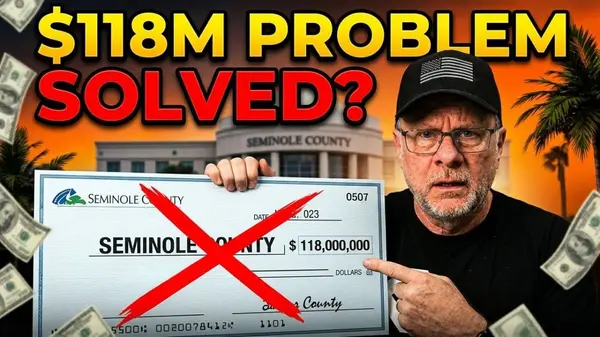
Why "Just Cut the Waste" Can't Fix the Florida Property Tax Hole
Watch the full video breakdown: https://youtu.be/VVYHkNmOcW8?si=5wZFe2e2KHxZlvTO
There is a comment that shows up continuously on recent videos about Florida property taxes. It goes something like this: "The county is sitting on an $8.3 billion budget. If they lose a little bit of property tax revenue, just cut the waste and move on."
It sounds like the most reasonable solution in the world. Yet, in practice, it is nearly impossible.
This difficulty does not exist because local government has zero waste. Waste almost certainly exists. The issue is where the money actually lives. Your county government does not operate out of one giant checking account. It operates out of dozens of separate, isolated accounts. Most of those accounts are locked by law to specific purposes, preventing funds from moving between them.
When someone suggests cutting waste to cover a tax cut, they are picturing a massive, single bank account that simply does not exist. To understand how proposed property tax changes will affect your pocketbook, you have to look at the underlying plumbing of local government finance.
The Timeline: How the Exemption Phases In
If voters approve the non-school homestead exemption amendment this November, it will not act like a light switch the morning after the election. The implementation phases in over time:
- Current State: Homestead exemption sits around $50,000.
- 2027: Exemption increases to $150,000.
- 2028 and Beyond: Exemption reaches $250,000, indexing to inflation after 2029.
Crucially, this proposed change does not touch school taxes at all. School district taxes operate under a separate board, a separate tax system, and a completely separate budget. This discussion centers strictly on the non-school side of local government.
Why the County Doesn't Have One Big Bank Account
When picturing a county budget, many imagine one big pot. Money flows in, county commissioners vote on spending, and money flows out. If that were true, handling a tax cut would be simple: trim spending in one area, move funds to another, and balance the books.
Instead, the budget consists of a row of locked accounts:
- Gas Taxes: Locked by state statute strictly into building and maintaining roads.
- Tourist Development Taxes: In a county like Orange, hotel taxes bring in over $360 million annually, but by law, that money is restricted to tourism, convention centers, marketing, and venues. Commissioners cannot spend it on hiring deputies.
- Impact Fees: Paid by developers, these funds are strictly limited to new infrastructure required by growth.
- Water Utilities: Your water bill pays for the water system and nothing else.
These statutory locks are not loopholes; they are the intentional design. They serve as a leash on local politicians, preventing leaders from redirecting road or utility funds toward pet projects.
The General Fund: The One Account That's Actually Flexible
Because almost every secondary account is restricted, every core service that is not a road, a hotel marketing campaign, or a water pipe must be funded by the single flexible account: the General Fund.
Services dependent on the General Fund include:
- The Sheriff's Office and local law enforcement
- Jails, courts, and public safety infrastructure
- County parks and public libraries
- Behavioral health and community safety nets
Out of a total $8.3 billion budget, Orange County's General Fund is roughly $1.73 billion. Once you strip out one-time funds, leftover balances, and pre-committed dollars, the recurring money generated by the General Fund is about $986 million.
Of that $986 million in recurring revenue, roughly 91% ($950 million) comes from a single source: property taxes.
The famous revenue diversity of Florida local government exists, but it lives inside locked accounts. The single flexible account that keeps core operations running relies almost entirely on property tax collection.
The DOGE Audit Problem: Two Walls "Just Cut" Runs Into
When state efficiency audits highlight waste in county operations, taxpayers naturally demand those dollars be cut first. However, relying solely on auditing runs into two immediate structural obstacles:
- Fund-by-Fund Separation: Audits rarely break down findings by individual locked accounts versus the General Fund. Recovering a wasted dollar inside a locked water utility or gas tax fund does not free up money for general operations. That recovered dollar remains legally locked inside the utility or road fund.
- Service Definition: Even when waste occurs inside the General Fund, one person's definition of waste is another resident's essential service. Trimming line items requires budget hearings, public debates, and political fights over specific programs like library hours, park maintenance, or community care.
The Real Cost: What Hits the General Fund
Using data from the state's revenue estimating framework and analysis from the Florida Association of Counties, expanding the non-school exemption to $250,000 carries an estimated countywide impact of about $253 million annually.
Isolating the direct hit to the General Fund specifically, the flexible budget stands to lose approximately $145 million to $150 million per year once fully implemented. That represents roughly 1 out of every 7 dollars in recurring general revenue, compounding annually as the exemption indexes to inflation.
Because tourist and gas tax dollars cannot cross over to cover the gap, local commissions are left with a direct mathematical challenge.
The Three Levers Counties Will Pull
To balance the flexible budget following a revenue drop, local governments have three primary mechanisms:
- Option 1: Cut Services. Commissioners can reduce spending out of the flexible account. While ballot summaries emphasize protecting core public safety, statutory text gives local commissions discretion on where reductions land. Cuts could impact libraries, park upkeep, or social services. You keep the property tax savings, but local amenities and services shrink.
- Option 2: Raise the Millage Rate. Counties can legally increase property tax rates on remaining taxable value to recover lost revenue. Because homesteaded owners receive the expanded exemption, the financial impact of a rate hike shifts disproportionately onto commercial properties, rental housing, and new residents who do not yet qualify for full exemptions. This option can lead to higher rents and increased local business overhead.
- Option 3: Flat Assessment Fees. Localities can implement or expand non-ad valorem special assessments for specific services like fire rescue or stormwater management. Because these are flat fees attached to real property rather than property value, they ignore the homestead exemption entirely. A flat $400 fee represents a minimal impact on a high-value estate, but impacts lower-priced starter homes significantly harder.
The Bottom Line for Florida Homeowners
The property tax reduction on homesteaded homes is real, offering roughly $2,000 in potential savings on a mid-priced primary residence. However, the cost of operating local government does not vanish simply because a single line item changes. The burden moves into service adjustments, millage rate shifts, or flat assessments on your annual statement.
Decisions on which options your community uses will not be made in state capitals. They will be decided inside your local county commission chambers during public budget hearings.
For complete insights into Florida real estate and local market updates, stay connected with Tom McNamara.
📘 Download the Sunshine State Handbook: https://b2amic-tw.myshopify.com/
Categories
Recent Posts