The Real Cost of Florida County Government: What They Aren't Telling You on Paper
Every time we talk about property taxes, local budgets, or relocating to Central Florida, the comment section lights up with the exact same frustration: “These county officials are way overpaid.”
It is easy to see why people get angry when they look at public paychecks. But here is the reality: if you think the headline salary listed on a government roster is the whole story, you are only seeing a small piece of the puzzle. What the job costs you on paper versus what it actually drains from your tax dollars are two completely different things.
When you break down the fully loaded executive packages, the state formulas, and the structural waste compounding across Florida counties, the real numbers are enough to make any taxpayer demand answers.
The Systemic Pension Load: A 40% Hidden Cost
Let's do some straight math using Orange County as a prime example. Byron Brooks, the County Administrator, carries a headline base salary around $305,000. Senior administrators across the region sit in similar brackets: Sheriff John Mina at $253,500, Orlando Mayor Buddy Dyer at $255,000, and County Mayor Jerry Demings at $227,812.
None of those numbers represent what the job actually costs you.
Every senior administrator in this tier sits in the Florida Retirement System (FRS) senior management class. The employer contribution rate for that specific class is 33.24% of gross salary. Add the mandatory 3% employee share, and you are looking at a 36.24% retirement funding load paid on top of their base salary every single year.
To put that in perspective, a private sector 401(k) match averages between 3.5% and 4.8%.
Here is how that breaks down on a standard $300,000 public executive:
- Base Salary: $300,000
- FRS Employer Pension Contribution: $99,720
- Health and Life Subsidy: $18,500
- Vehicle & Tech Allowance: $4,800
- Total Taxpayer Cost: $423,020
The headline salary you see in the news is only 71% of the actual check taxpayers write. Compare that to a private sector executive with the same $300,000 base. With standard private matches and benefits, the total cost to the company is roughly $327,700. The private employer pays 1.09 times the base salary; Florida taxpayers pay 1.41 times the base. That is a 40% gap between what you read and what you pay.
It Is Not an Outlier: The Statewide Pattern
This is not isolated to one aggressive contract in Orlando. It is a statewide operational model.
- Sarasota County: Administrator Jonathan Lewis has a base salary of $284,252, but his fully loaded benefits and pension package reaches $460,000. County Attorney Joshua Moye makes $262,953 in base, carrying a fully loaded package of $422,000. That is over $160,000 disappearing into perks and retirement before evaluating if the base is even fair.
- Lee County: The administrator earns $286,200, while their county attorney takes home $341,433.
- Collier County: Administrator sits at $270,000.
- Volusia County: Administrator earns $259,041.
- Polk County: Administrator sits at $256,206.
County after county, the pattern holds firm: a $250,000 to $350,000 base carrying an immovable 33.24% pension load on top.
The Statutory Formulas Nobody Voted For
When taxpayers get furious about these numbers, they usually head straight to local county commission meetings. But there is a secondary layer of government at play that local voters completely overlook.
Take Seminole County Sheriff Dennis Lemma, who earns $257,625. That pay figure is not a local commissioner's discretionary decision. It is dictated by Chapter 145.071 of the Florida Statutes, a population-based pay formula written in Tallahassee. Local county commissioners cannot vote it down. While you are focusing your frustration on local officials, state legislators have put half of the bill on statutory autopilot with zero direct local accountability.
Even in smaller rural areas like Levy County (population 45,000), where County Manager Mary Ellen Harper makes $145,000, Sheriff Bobby McCallum earns $182,500 due to these exact same statutory formulas. Rural counties with smaller commercial tax bases are forced to absorb the exact same rigid pension structures and state formulas as high-growth metropolitan hubs.
Exposing the Waste: The $48 Million Audit Finding
While high salaries spark public debate, structural spending growth is where the real taxpayer money evaporates.
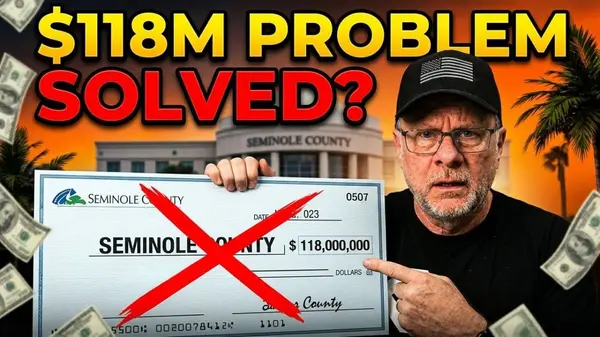
In October, Florida Chief Financial Officer Blaise Ingoglia audited Seminole County. The audit revealed that the county's general fund grew by $136 million (a 46.7% increase) over six years, while adding only 25,338 new residents. The CFO’s office explicitly labeled $48 million of that growth as excessive, wasteful spending. That is 10.85% of the entire operating budget tagged as pure structural excess.
Where did that money compound line by line over six years?
- State retirement contributions: Up 151.2%
- Court support services: Up 121.7%
- Transportation and stormwater: Up 108%
- County jail operations: Up 53.4%
- Sheriff’s office budget: Up 51.2%
Instead of trimming the fat, the county commission voted to increase the millage rate from 4.8751 to 5.3751, pulling an additional $27 million directly out of property owners' pockets to cover the gap.
The Imminent Impact of Amendment 3
This compounding spending sets up a major conflict for Florida property owners looking ahead to Amendment 3 on the ballot. If passed, Amendment 3 would raise the homestead exemption to $150,000 in 2027 and $250,000 in 2028.
State estimates project this will cut local government revenues by $4.6 billion in year one and $8.4 billion in year two. Orange County alone stands to lose $165 million in 2027 and $275 million in 2028.
When that revenue vanishes, what actually gets cut? It will not be the public pensions, which are protected by state statute. It will not be multi-year union contracts. Because personnel and retirement eat 50% to 85% of county general funds, local governments will be forced to cut non-guaranteed public services like parks, road repairs, and public libraries.
What This Means for Buyers, Renters, and Investors
Whether you own a home, rent, or invest in Florida real estate, these structural budget mechanics affect your bottom line:
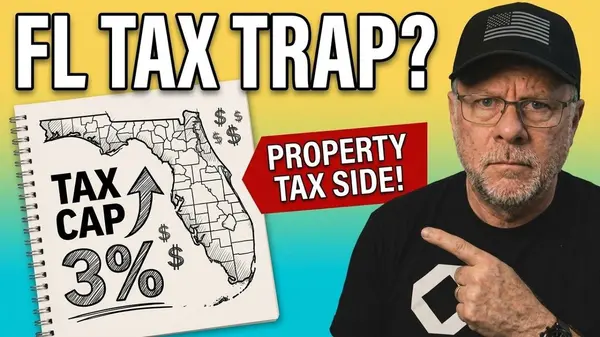
- First-Time Homebuyers: Unlike long-term owners protected by historic Save Our Homes assessment caps, new buyers reset their tax base at current market values. You inherit the full weight of these compounding county budgets from day one.
- Real Estate Investors: Non-homestead properties are subject to different tax caps. As counties scramble to replace lost revenue, commercial and residential investment properties carry a disproportionate share of local tax hikes.
- Relocating Buyers: In Seminole County alone, the audit showed local government budget growth equaled $5,420 for every new resident added over six years ($21,680 for a family of four). Knowing the fiscal health of a county before buying is critical to protecting your long-term wealth.
Partner with a Local Insider
Navigating the Florida real estate market requires looking beyond listing prices and square footage. You need to understand local tax trajectories, budget impacts, and community infrastructure before making a move.
📘 Download the Sunshine State Handbook: https://b2amic-tw.myshopify.com/
Ready to buy, sell, or relocate with complete clarity? Connect with Tom McNamara and The McNamara Experience team today to ensure your next investment is backed by real local insight.
Categories
Recent Posts