The Number Nobody Voted On: How SB 4F, HB 1329, and Amendment 3 Put a Check on Florida Property Taxes
https://youtu.be/V5yzrljvdvM?si=_StY5BXQlxjhzvk0
In the 2015 fiscal year, local governments and school districts across Florida levied $28.3 billion in property taxes. Last year, that figure reached $43 billion. That represents a 52% jump, funneling $14.7 billion in new revenue to local governments in under a decade.
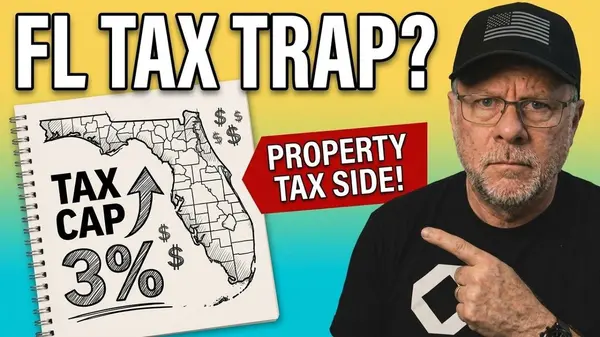
Nobody voted on that $43 billion number directly. However, for the first time, three specific measures are converging to put an actual check on how local tax increases happen: Senate Bill 4F (SB 4F), House Bill 1329 (HB 1329), and Amendment 3.
SB 4F: The Law That Is Live Right Now
Signed on June 24th and made effective immediately, SB 4F has already reshaped how city and county commissions negotiate tax rates.
Prior to SB 4F, a county could increase its maximum millage rate every year using a formula tied to statewide personal income growth. Passing those increases required only a simple majority vote, creating very little political friction.
SB 4F eliminates that personal income growth formula. Under this law, the maximum millage rate a commission can adopt with a simple majority is pinned directly to the certified rolled back rate. The rolled back rate is the exact rate required to raise zero new tax dollars off existing properties.
If a commission wants to exceed the rolled back rate, new vote thresholds apply:
- Two-Thirds Supermajority Vote: Required to pass any rate above the certified rolled back rate up to 110% of that rate.
- Unanimous Vote or Public Referendum: Required to push the proposed millage rate past 110% of the rolled back rate.
A Real Test Case: The City of Apopka
The real-world impact of SB 4F was demonstrated this summer in the City of Apopka. City staff originally requested a full 1 mil rate increase, moving the millage rate from 4.4376 to 5.4376 mills. This proposal was nearly 28% above the city's rolled back rate of 4.2510 mills.
Because the proposed rate sat past the 110% threshold, SB 4F required unanimous agreement from all five city commissioners. Commissioner Nadia Anderson refused to support the increase, stating that her residents repeatedly reported they could not afford another tax hike without the city finding spending cuts first.
Because of that single holdout vote, the process unfolded over multiple weeks and meetings:
- First Attempt: The commission tabled the initial 1 mil proposal due to lack of unanimity.
- Second Attempt: Staff returned with a revised three-quarter mil proposal. Because it remained above the 110% line, it still required unanimous support. Commissioner Anderson held her position, and the measure was tabled again.
- Final Resolution: Four days before the state deadline—after which the city would have been legally capped at the bare rolled back rate with no tax increase—the commission agreed to a compromise rate of 4.6761 mills.
This final 10% increase fell under the 110% threshold, meaning it only required a two-thirds supermajority vote. It passed 4:1, with Commissioner Anderson voting no on the record. Following this debate, the mayor introduced monthly budget workshops and earlier public comment windows.
SB 4F does not automatically block a tax increase. Instead, it changes the legal mechanism so that larger tax increases require a higher level of consensus among elected officials.
HB 1329: Transparency and Leverage Coming January 2027
While SB 4F governs current rate votes, HB 1329 takes effect on January 1st, 2027. This law will apply to the budget cycles local commissions build for the upcoming fiscal year.
Currently, local governments can release lengthy budget workbooks just two days before holding the final vote that sets property tax bills. Starting January 1st, 2027, HB 1329 mandates several operational changes:
- 14-Day Advance Posting: Tentative budgets must be posted online at least 14 days before public hearings and must include explanatory narratives and graphics rather than basic spreadsheet data.
- 5-Year Budget Retention: Final approved budgets must remain accessible online for five years, up from the current two-year requirement.
- Quarterly Compensation Disclosures: Cities and counties must publish online quarterly breakdowns of employee compensation funded by tax dollars, including employee names, job titles, and exact salaries.
The Mandatory 10% Cut Menu
HB 1329 introduces a specific requirement intended to provide public leverage during budget negotiations.
Starting in the 2027 budget cycle, every local government must hold a dedicated public workshop at least 14 days before the final budget vote. During this workshop, staff must present a published, downloadable menu identifying specific ways to cut the proposed budget by 10%.
By law, these proposed 10% cuts cannot touch essential public safety services, specifically police, fire, and EMS.
The Gap: Non-Ad Valorem Assessments
Neither SB 4F nor HB 1329 applies to non-ad valorem assessments. Last year, Florida county tax collectors processed $52.9 billion total, which is nearly $10 billion higher than the $43 billion collected in traditional ad valorem property taxes.
That $10 billion gap consists of non-ad valorem fees for services such as solid waste, stormwater, fire, and EMS. These items appear on the standard property tax bill but are calculated differently.
Local governments often use special assessments because they sit outside the constitutional 10 mil ad valorem cap, fall outside SB 4F's rolled back rate rules, and are exempt from supermajority voting requirements and HB 1329's mandatory 10% cut workshops.
Amendment 3: Ballot Rewrites and Proposed Structural Changes
Amendment 3 will appear on the statewide ballot this November 3rd.
The original title for the measure was "Save Our Homes from Excessive Property Taxes." Following a lawsuit filed by three separate groups, a Leon County judge ruled that the original wording was misleading and political. The state did not appeal, resulting in a court-ordered title rewrite: "Increased Homestead Exemption, Lower Cap on Increases in Nonhomestead Property Assessments."
A follow-up poll testing both titles head-to-head showed that voters shown the original wording supported it at 60%, while voters shown the court-ordered plain description supported it at 65%, with the polling organization noting that the 5-point difference fell within the margin of error.
Core Provisions of Amendment 3
If approved by voters, Amendment 3 would enact the following changes:
- Homestead Exemption Increases: Increases the homestead exemption for non-school property taxes to $150,000 on January 1st, 2027, and to $250,000 in 2028.
- Local Exemption Authority: Directs the Legislature to establish a uniform statewide procedure allowing counties and cities to increase the exemption further, up to the home's full assessed value. Special districts could offer similar increases if approved by local voters via a referendum.
- Non-Homestead Assessment Cap: Reduces the annual assessment growth cap on non-homestead properties (including commercial real estate, residential rentals, and second homes) from 10% down to 5% starting in 2027.
- Restricted Tax Revenue Uses: Limits the use of general property tax dollars strictly to public safety, education, infrastructure, natural resources, bond debt, retirement obligations, and basic government operations.
Under current statutory frameworks, ad valorem property taxes can legally fund discretionary expenditures, including Children's Services Councils (under F.S. 125.901), Community Redevelopment Agency (CRA) trust funds that redirect up to 95% of incremental tax growth (under F.S. 163.387), and Economic Development Council contracts with private developers (under F.S. 125.045). Amendment 3 contains language designed to restrict general property taxes from funding discretionary categories outside its enumerated list.
Utilizing Public Tools to Track Local Budgets
Existing Florida Sunshine Laws allow any resident to request line-item details, municipal contracts, and CRA disbursements from local government entities. Beginning in 2027, HB 1329 will require local governments to publish these baseline financial details automatically.
For buyers relocating to Florida, homestead exemptions phase in over time, making early tax bill tracking essential. For existing homeowners, these procedural rules explain why tax bills can rise even when local millage rates remain flat.
If you have questions about how local property tax changes affect your home purchase, sale, or equity in Central Florida, feel free to reach out to Tom McNamara directly.
📘 Download the Sunshine State Handbook: https://floridarealestateinsider.com/vip-pass
Categories
Recent Posts